You might survive without Wi-Fi, luxury, or even your morning coffee—but you certainly can’t survive without food. More than just a basic necessity, food is the very foundation of life, quietly sustaining every heartbeat, every dream, and every step of humanity’s journey. In many ways, it is the silent force behind much of what we do. People wake up early, toil through long hours, chase opportunities, and strive relentlessly—often with one simple, universal purpose at the heart of it all: to put food on the table.
Food is far more than just a means to quiet a rumbling stomach. It nourishes the body, fuels our energy, and sustains life itself. Beyond its physical role, food also has a deeply emotional dimension. A warm home-cooked meal can soothe a tired soul, a favourite dish can instantly lift one’s mood, and certain flavours can transport us back to cherished memories and comforting moments. In many homes and cultures, food becomes a language of its own—an unspoken expression of love, care, and belonging.
However, you choose to look at it—whether as nourishment, comfort, tradition, or affection—food remains something profoundly essential. Without it, life simply cannot exist, and with it, life becomes richer, warmer, and infinitely more meaningful.
As the years pass and the world moves forward with rapid modernization and industrialization, our appetites evolve too. What once revolved around simple, home-cooked meals has now expanded into a dazzling array of choices. Supermarket shelves overflow with colorful packages, exotic flavors, and foods from every corner of the world, promising convenience, variety, and instant satisfaction.
Behind this abundance, however, lies an equally fast-paced system of mass production and growing urban demand. Companies work tirelessly to keep up with the ever-increasing appetite of expanding cities and changing lifestyles. In this race to meet demand, profit naturally becomes a crucial driver of business decisions. Yet when profit begins to overshadow everything else, the delicate balance between quantity and quality can quietly begin to tilt.
And it is often in these unnoticed cracks—between speed, scale, and the pursuit of profit—that an unsettling practice finds room to grow: food adulteration. What begins as a small compromise can slowly blur the line between nourishment and deception, raising an important question about the food that eventually reaches our plates.
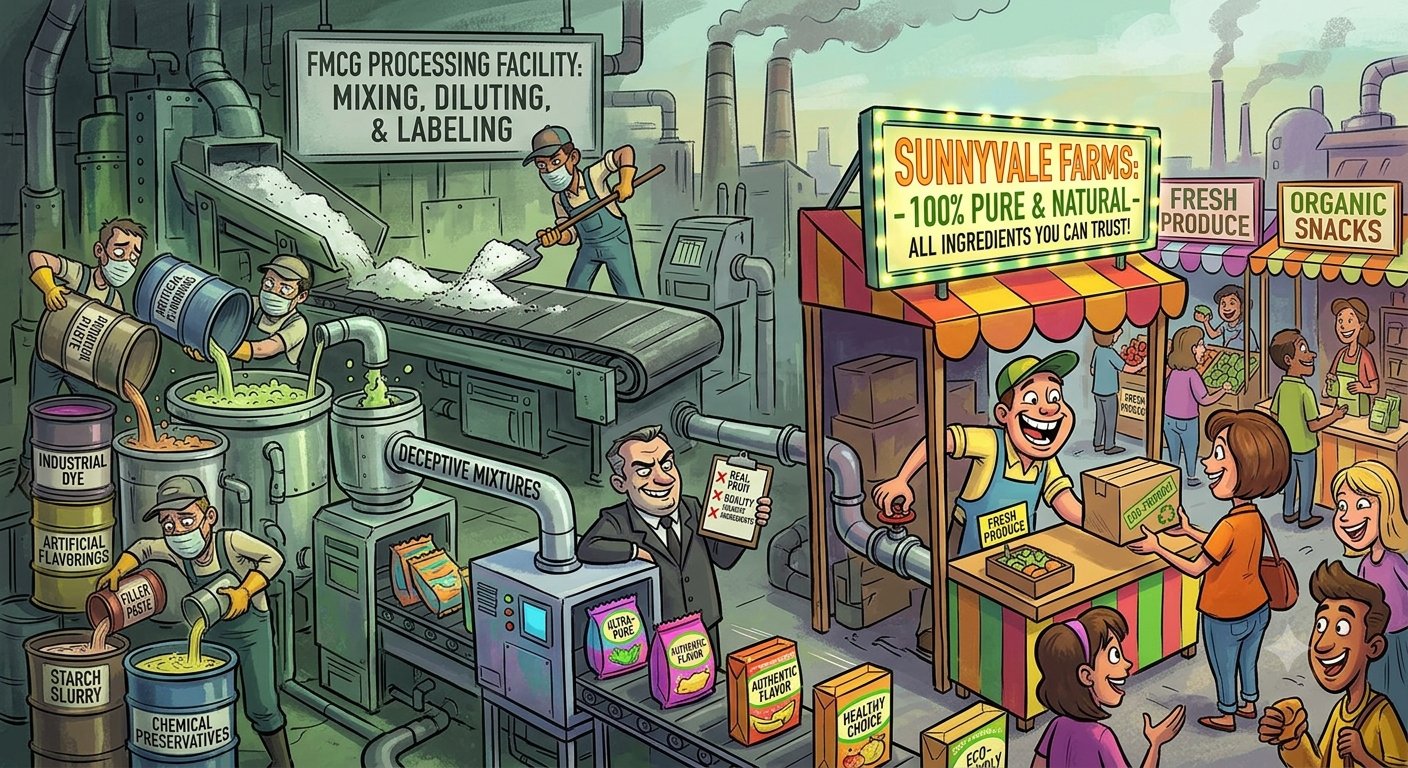
What makes food adulteration particularly alarming is that it rarely announces itself. It doesn’t come with warning labels or obvious signs. Instead, it quietly slips into our kitchens, our lunchboxes, and our dining tables—hidden behind attractive packaging, vibrant colours, tempting aromas, and promises of freshness. And that raises an unsettling question: How well do we really know the food we trust with our lives every single day?
Eye-catching advertisements persuade us that packaged foods are not only convenient but also the perfect addition to our busy lifestyles. Bright labels proudly proclaim words like “healthy,” “natural,” “low-fat,” or “fortified,” while the fine print and ingredient lists often go unnoticed. Drawn in by attractive packaging and clever marketing, we rarely pause to ask what we’re really putting into our bodies.
In a world where convenience often takes precedence, saving a few minutes has become far more appealing than spending time understanding what we eat. We choose foods that are quick to prepare, easy to grab, and heavily promoted, often overlooking the hidden additives, excessive preservatives, artificial ingredients, or misleading claims that may accompany them. While these choices may save us time today, they can quietly take a toll on something far more valuable—our health.
The consequences rarely appear overnight. Instead, they accumulate gradually, hidden behind our fast-paced routines and everyday habits. What begins as a harmless shortcut can, over time, become a silent compromise, reminding us that convenience should never come at the cost of our well-being. After all, the greatest investment we can make isn’t in saving a few extra minutes—it’s in protecting the body that has to carry us for a lifetime.
But what exactly is food adulteration? Contrary to what many people believe, it isn’t always about visibly spoiled food or something that looks suspicious. More often than not, adulteration hides in plain sight. It can involve the deliberate addition of cheaper or inferior substances, the removal of valuable nutrients, the use of unauthorized chemicals, or practices that compromise the purity, quality, and safety of food—all with the intention of cutting costs, extending shelf life, improving appearance, or increasing profit.
The unsettling reality is that food adulteration isn’t confined to one type of product. It can be found in everyday essentials such as milk, spices, cooking oils, honey, tea, coffee, grains, fruits, vegetables, sweets, and even packaged foods that many of us consume without a second thought. Because these products often look, smell, and taste perfectly normal, most consumers remain completely unaware that anything is amiss.
This is precisely what makes food adulteration so dangerous. It doesn’t always reveal itself immediately. Instead, it quietly chips away at the trust between consumers and the food they eat. While some adulterants may only reduce the nutritional value of food, others can pose serious health risks when consumed regularly over time. The danger lies not just in what is added to our food, but in the fact that we often never know it’s there in the first place.
So, why does food adulteration continue to exist despite stricter regulations and growing public awareness? The answer isn’t as simple as blaming a single person or industry. In an increasingly competitive marketplace, where consumer demand is constantly rising and expectations continue to evolve, businesses often face immense pressure to produce more, deliver faster, and keep prices affordable. While the vast majority of food producers operate responsibly and uphold quality standards, there are instances where some choose shortcuts over integrity. Whether it’s to reduce production costs, extend shelf life, improve appearance, or maximize profits, these compromises can gradually erode the quality and authenticity of the food that reaches consumers.
At the same time, consumers unknowingly play a role in this cycle. We are naturally drawn to products that are cheaper, brighter, fresher-looking, and longer-lasting, often without questioning how these qualities are achieved. Attractive packaging, persuasive advertisements, and irresistible discounts can easily influence our decisions, shifting our attention away from what truly matters—the quality and safety of the food we bring into our homes. In many ways, food adulteration thrives not only because someone chooses to adulterate food, but also because it often goes unnoticed by those consuming it.
The challenge, therefore, is not merely to identify adulterated food but to become more informed and conscious consumers. Awareness is the first line of defence. The more we understand what we eat, how it is produced, and what warning signs to look for, the better equipped we are to protect ourselves and our families from hidden risks.
From everyday essentials such as milk, spices, edible oils, and honey to fresh fruits, vegetables, and sweets, adulteration has found its way into foods that millions of people trust without a second thought. What makes the issue particularly alarming is that many adulterants are invisible to the naked eye, leaving consumers with little reason to suspect that the food on their plates may not be as pure or safe as it appears.
This raises an important question: if adulteration is so common, what exactly is being added to our food, why is it done, and what consequences does it have for our health? Understanding these hidden practices is essential to recognising the true cost of the food we consume and why this issue deserves far greater attention than it often receives.
While stronger regulations, stricter enforcement, and ethical business practices are essential to tackling food adulteration, lasting change also depends on informed consumers. Taking a few extra moments to read labels carefully, buy from trusted sources, stay aware of common adulteration practices, and question products that seem unusually cheap or too good to be true can make a meaningful difference. Even small habits, such as checking expiry dates, comparing ingredients, and paying attention to the appearance, smell, or texture of food, can help us make safer choices.
Every conscious decision we make not only protects our own health and that of our families but also encourages greater accountability throughout the food industry. When consumers consistently choose safe, transparent, and high-quality products while avoiding brands that compromise on quality, businesses are encouraged to prioritise cleaner ingredients, better manufacturing practices, and greater transparency. As demand for honest and safe food grows, companies are more likely to recognise that trust is not built through clever marketing or low prices, but through consistently delivering products that consumers can rely on with confidence.
Food is more than just fuel—it is the foundation of our health, our well-being, and our daily lives. Yet every act of adulteration chips away at the trust we place in the food on our plates, often without us even realizing it. Combating this silent threat is not the responsibility of governments, regulators, or food manufacturers alone; it is a shared responsibility that begins with awareness and grows through informed choices and ethical practices. The more we question, learn, and demand transparency, the harder it becomes for unsafe practices to thrive.
The true cost of adulterated food is rarely seen at the checkout counter; it is revealed later in the health we lose, the risks we ignore, and the trust we break. So, before the next purchase, perhaps the real question is not whether the food is affordable, but whether it is safe enough to deserve a place on our table.
Leave a Reply