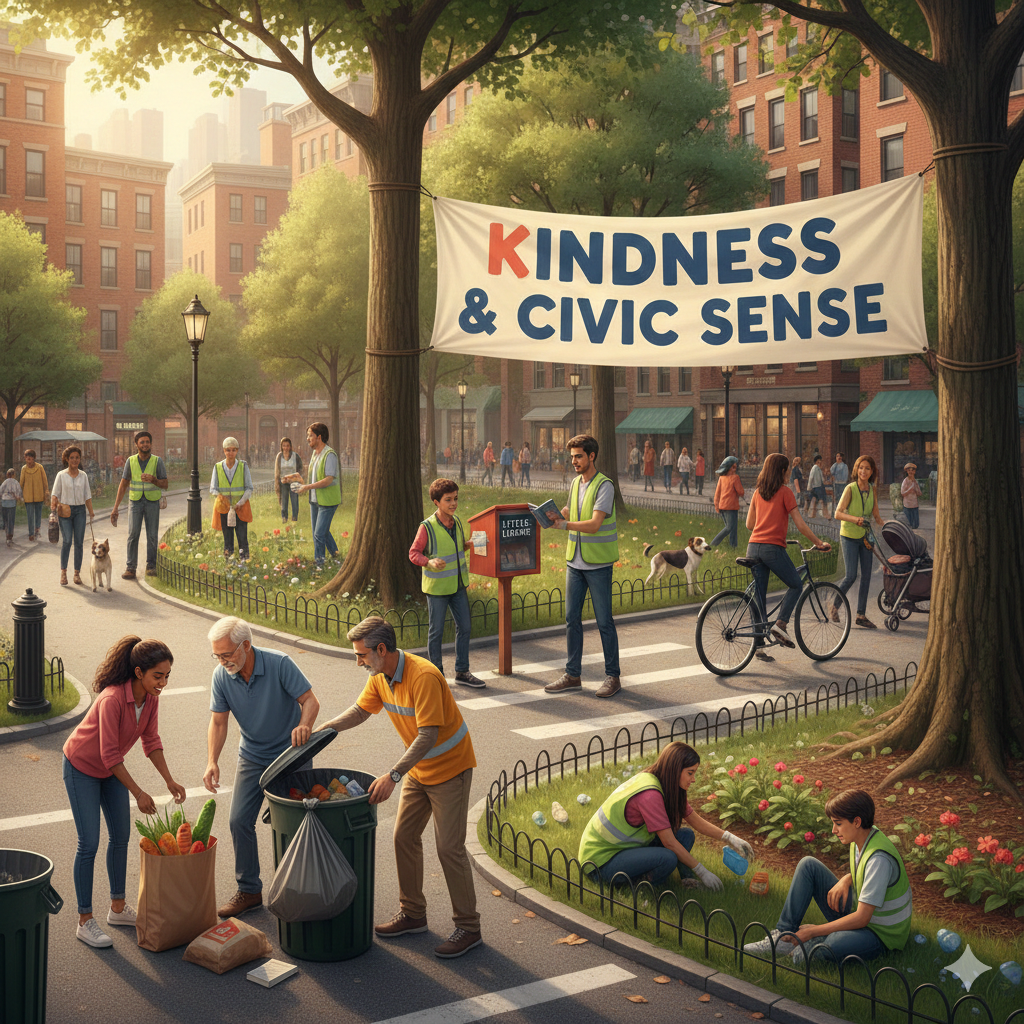
How often do we pause to reflect on how today’s world seems to be losing the basic kindness that once came so naturally to people—qualities that now feel rare and almost invisible. How often do we truly witness someone stepping in to help another in distress, not for recognition or reward, but purely out of humanity and civic sense. And perhaps more importantly, how clearly do we ourselves understand what these qualities truly mean? Do we genuinely value them, or even recognize whether we possess them?
We celebrate prestigious degrees, admired job titles, and impressive social status as markers of success. Yet shouldn’t we hold kindness and civic sense—the most fundamental and life-sustaining human qualities—in equally high regard? After all, these are the very traits that make our communities humane, our public spaces livable, and our world worth sharing. Ignoring them slowly erodes the social fabric that binds us together. We are often awed by a person’s education, the brands they wear, or the company they work for. But how often do we pause to value qualities such as being grounded, respectful, and socially responsible as true measures of character? Do we acknowledge these traits with the same admiration we reserve for material or professional achievements?
This leads to an uncomfortable but necessary question: are kindness and civic sense truly linked to good education, privileged backgrounds, or high-profile careers? The truth is, possessing impressive qualifications does not automatically make someone kind or considerate. Degrees may shape the mind, and status may elevate social standing, but it is everyday choices—small, consistent acts of empathy and responsibility—that reveal who a person truly is.
Kindness and civic sense rarely announce themselves loudly. They appear in quiet moments—waiting patiently, respecting shared spaces, offering help without being asked, choosing empathy over indifference. These acts may seem small, almost insignificant in a world chasing speed, success, and visibility, yet they carry the power to shape everyday life. When practiced consistently, they create trust among strangers and a sense of belonging within communities. Their absence, however, is felt immediately—in impatience, disregard, and the growing emotional distance between people. Perhaps the reason they feel so rare today is not because they no longer exist, but because we have stopped nurturing and noticing them.
Kindness and civic sense are not lofty ideals reserved for moral debates—they are exposed in the smallest, most ordinary moments of our daily lives. They reveal themselves in how we treat public spaces, how we follow rules when no authority is watching, and how we respond to inconvenience. They are present when we choose not to litter, not to honk mindlessly, not to cut queues, not to humiliate someone for our own momentary power. Kindness is not weakness; it is the discipline of empathy. Civic sense is not obedience; it is the understanding that our comfort cannot come at the cost of another’s dignity. The uncomfortable truth is this: society does not decay because of a lack of laws or education—it erodes because of everyday indifference. The real question we must confront is not whether the world lacks kindness, but whether we are willing to practice it when it demands effort, restraint, and accountability from us.
In reality, these traits are among the most valuable qualities a person can possess. They not only reflect an individual’s character but also shape the true identity of a city or a nation. A society where more people consistently display kindness and civic sense is often one that is genuinely developed and progressive—not merely in infrastructure or technology, but in moral responsibility. Such collective behavior becomes a form of soft power, quietly strengthening a country from within as citizens act with care, accountability, and respect toward their shared spaces and one another.
In today’s tech-savvy era, social media frequently highlights this contrast. We often come across posts praising communities where people act responsibly—helping strangers, maintaining public spaces, following rules, and contributing positively to development. These places are admired not only for being technologically advanced or well-equipped, but for the way their people uphold civic responsibility. On the other hand, we also witness the consequences of a lack of these qualities: careless littering that begins at home and spreads to streets, cities, and entire regions; public property being damaged; people mistreating one another without concern. Such behavior quietly but steadily undermines any effort toward meaningful growth and long-term progress.
Another crucial aspect we must recognize is that observing these traits in others should not end with admiration alone. We must learn to internalize and practice them in our own lives. Kindness and civic sense should never be mistaken for weakness, nor should they be taken for granted or exploited. They demand strength, self-awareness, and moral clarity. When practiced consciously and collectively, these qualities do more for a nation’s advancement than any policy or technological breakthrough ever could.
As we move toward any conversation about progress and development, there is an uncomfortable gap that must be addressed. Many of us travel to or admire clean, well-organized, and developed countries and return impressed by their systems, discipline, and civic responsibility. Yet, admiration often stops at observation. Rarely does it translate into genuine effort to practice those same values back home. Civic sense is not something that belongs to a country—it belongs to its people. If we can follow rules, respect public spaces, and act responsibly abroad, the real test lies in whether we are willing to do the same in our own streets, cities, and communities. This shift in mindset must also begin early. Schools cannot limit education to academics alone; they must actively instill habits of kindness, responsibility, respect for shared spaces, and empathy right from kindergarten. When children grow up practicing these values daily—not as instructions, but as lived behavior—they carry them forward into adulthood. A nation’s future is shaped less by what children memorize and more by what they repeatedly practice.
And this is where the reflection must turn inward. It is easy to criticize society, blame systems, or mourn the loss of values—but far harder to confront our own role in their decline. Kindness and civic sense do not disappear overnight; they fade each time we choose convenience over responsibility, silence over action, indifference over empathy. The state of our world is not an abstract failure—it is a collective mirror. The question that remains is deeply personal and impossible to ignore: if everyone behaved the way we do, what kind of society would exist tomorrow? Until we are willing to answer that honestly—and change accordingly—no level of development, technology, or global admiration will truly make us advanced. Because in the end, the true measure of progress is not how far a nation has advanced, but how responsibly its people choose to live.
Leave a Reply