
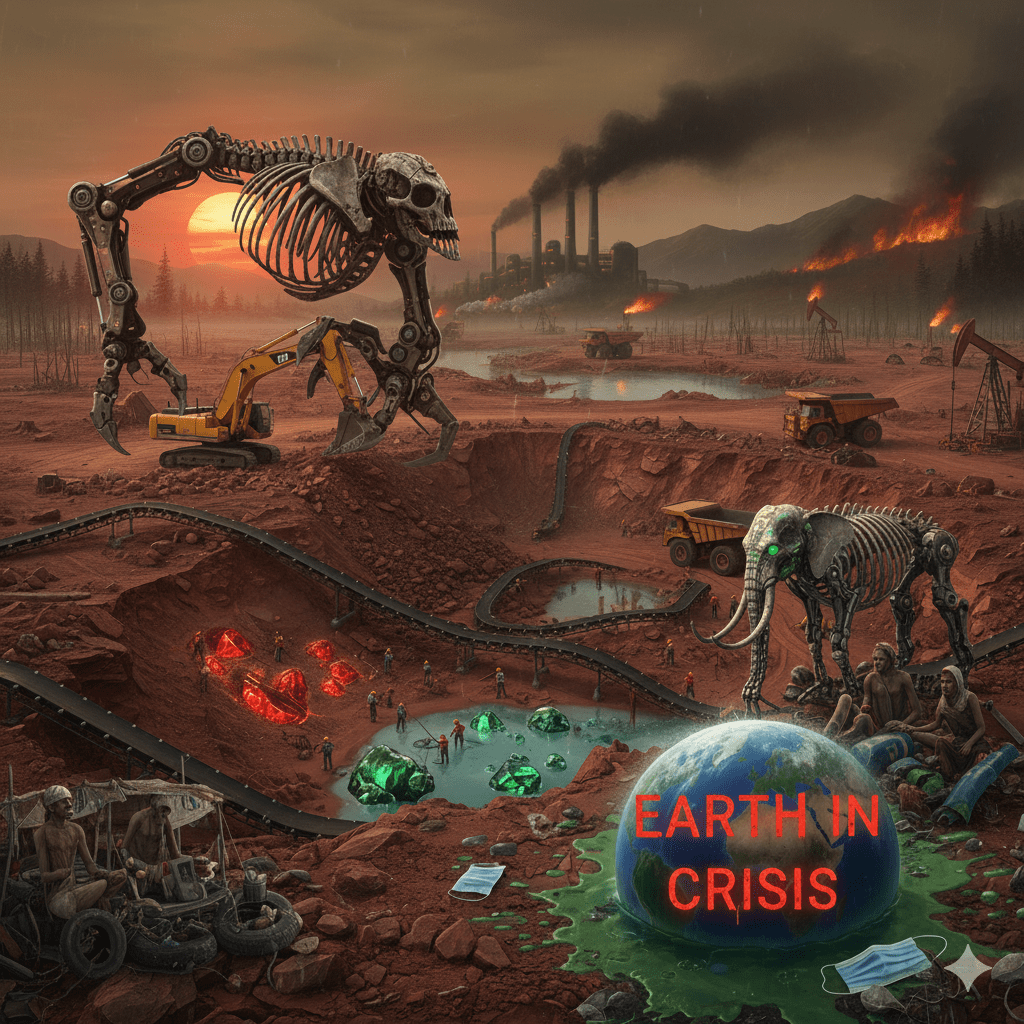
Have you ever looked at the sky and noticed it’s no longer the same as it once was—the clear, sapphire-blue sky, the sun shining so brightly that its rays made the leaves glisten like emeralds, the air so crisp it left you feeling completely refreshed? But now, it’s different. Have you ever wondered why does nature now rage with sudden storms, relentless heatwaves, and unseasonal floods, where that serene gentle, life-giving climate has gone, why nature seems harsher and more unpredictable with each passing day as if the Earth itself is gasping for breath? Each day, the balance we once took for granted slips further away, leaving us to confront a world both mesmerizing and terrifying—a world veiled in smoke and suffocating under the weight of our choices.
This drastic shift didn’t happen overnight. It is the result of decades of relentless human activity—forests cleared for short-term gains and to make way for cities, rivers choked with industrial and plastic waste, skies clouded with smoke from factories and vehicles. Carbon emissions rise unchecked, melting glaciers at unprecedented rate, oceans warming and acidifying, and fuelling extreme weather events, storms grow more violent with each passing year. Every choice we make, from the energy we consume to the products we discard, leaves a mark on the Earth’s delicate balance.
The evidence is all around us, yet society often treats these warning signs as distant or abstract, failing to recognize that every discarded plastic bottle or burning fossil fuel contributes to a planet pushed to its limits. This is not merely change—it is a warning, a cry from a planet under siege. And yet, despite the warnings etched into storms, droughts, and wildfire scars, we continue to turn a blind eye, as if the planet’s quiet suffering is someone else’s problem. But there is no “someone else.” The responsibility falls on all of us, and every decision we make today can either deepen the wound or help heal the planet. It is time to wake up, take notice, and act—before the Earth’s gasp becomes irreversible.
Understanding Climate Change and Global Warming
Climate change refers to long-term shifts in temperatures, weather patterns, and ecological systems on Earth, while global warming specifically describes the observed rise in average global surface temperatures, primarily since the Industrial Revolution. These phenomena are interconnected, with global warming being the primary driver of broader climate change. According to scientific consensus from organizations like the United Nations, NASA, and the Intergovernmental Panel on Climate Change (IPCC), human activities are responsible for virtually all observed warming over the last 200 years, accelerating changes far beyond natural variability.
The Greenhouse Effect: The Fundamental Mechanism
The Earth’s natural greenhouse effect keeps the planet habitable by trapping some of the sun’s heat in the atmosphere through gases like water vapor, carbon dioxide (CO₂), and methane. However, human-induced increases in these greenhouse gases have intensified this effect, leading to excess heat retention and global warming. Without this amplification, Earth’s average temperature would be about 33°C (59°F) cooler. The IPCC estimates that global temperatures have risen by about 1.1–1.2°C since pre-industrial times, with the last decade (2011–2020) being the warmest on record.
Primary Causes: Human Activities
Human actions, particularly since the mid-20th century, account for the rapid warming trend. The main culprits are the emission of greenhouse gases from energy production, industry, and land use. Fossil fuels—coal, oil, and natural gas—are the largest contributor, responsible for over 75% of global greenhouse gas emissions and nearly 90% of all CO₂ emissions. Below is a breakdown of key human-driven causes:
| Cause | Description | Contribution to Warming | Key Sources |
| Burning Fossil Fuels | Combustion for electricity, heat, and transportation releases CO₂ and other gases, trapping heat in the atmosphere. | ~75% of total emissions; dominant since Industrial Revolution. | Power plants, vehicles, factories. |
| Deforestation and Land Use Changes | Clearing forests for agriculture or development reduces CO₂ absorption (trees act as carbon sinks) and releases stored carbon. | ~10–15% of emissions; net warming effect despite some reflectivity increase. | Logging, farming expansion in tropics. |
| Agriculture and Livestock | Methane (CH₄) from rice paddies and cow digestion; nitrous oxide (N₂O) from fertilizers. Methane is 25–80 times more potent than CO₂ over short periods. | ~24% of emissions; short-term warming accelerator. | Farming, manure management. |
| Industrial Processes | Emissions of fluorinated gases (e.g., HFCs) and N₂O from manufacturing; these have high global warming potential (up to 23,000 times that of CO₂). | ~5–10% of emissions; potent but lower volume. | Cement production, refrigeration, chemicals. |
| Waste and Urbanization | Methane from landfills; urban heat islands from concrete absorbing more heat. | emissions (~3%), but amplifies local warming. | Landfills, building materials. |
These activities have elevated atmospheric CO₂ levels from ~280 ppm pre-industrially to over 420 ppm today, driving the observed temperature rise.
Why It Matters: Distinguishing the Terms
Global warming is the temperature increase, while climate change encompasses cascading effects like rising sea levels (up ~16–21 cm since 1900), intensified storms, droughts, and biodiversity loss. Keeping warming below 1.5°C—per the Paris Agreement—requires slashing emissions, as current policies project up to 3.1°C by 2100. Addressing these causes through renewable energy, reforestation, and sustainable agriculture is essential to mitigate impacts.
The Human Cost (Impact)
The consequences are no longer distant headlines; they are lived realities. Children grow up breathing toxic air that damages their lungs before they even learn to read. Farmers watch their crops wither under relentless droughts or vanish in sudden floods. Cities choke on smog, while villages vanish under rising seas. Climate change and pollution do not discriminate, yet the poorest and most vulnerable are always the first to suffer.
This crisis does not strike equally the wealthy can buy bottled water, air purifiers, and escape routes. But the poor—those who contributed the least to the problem—are left on the frontlines of climate collapse. For them, a failed harvest means hunger; a storm means losing everything. Pollution and climate change are not only environmental issues; they are also questions of justice, dignity, and survival. Each smog-filled morning, each vanishing shoreline, is a reminder that the Earth’s suffering is inseparable from our own. The Earth’s wounds are etched into human lives, reminding us that the environmental crisis is also a humanitarian one.
The Urgency
And yet, too often, we respond with silence—or with half-measures wrapped in greenwashed promises. Time is slipping away faster than we imagine. Scientists warn that we are approaching tipping points: melting ice sheets that could drown coastlines, Coral reefs, the rainforests of the sea, are bleaching and dying, taking with them countless species and disrupting food chains that support millions of people. Deforested lands risk turning into deserts, while once fertile soils lose their life.
Collapsing ecosystems that could destabilize food supplies, forests that may never return. We are not just endangering the Earth’s beauty; we are gambling with its ability to sustain life as we know it. This is no longer a matter of tomorrow. It is happening here and now, and our window for action is closing. The question is no longer if we will act, but when—because hesitation will cost us everything.
A Call to Hope and Action
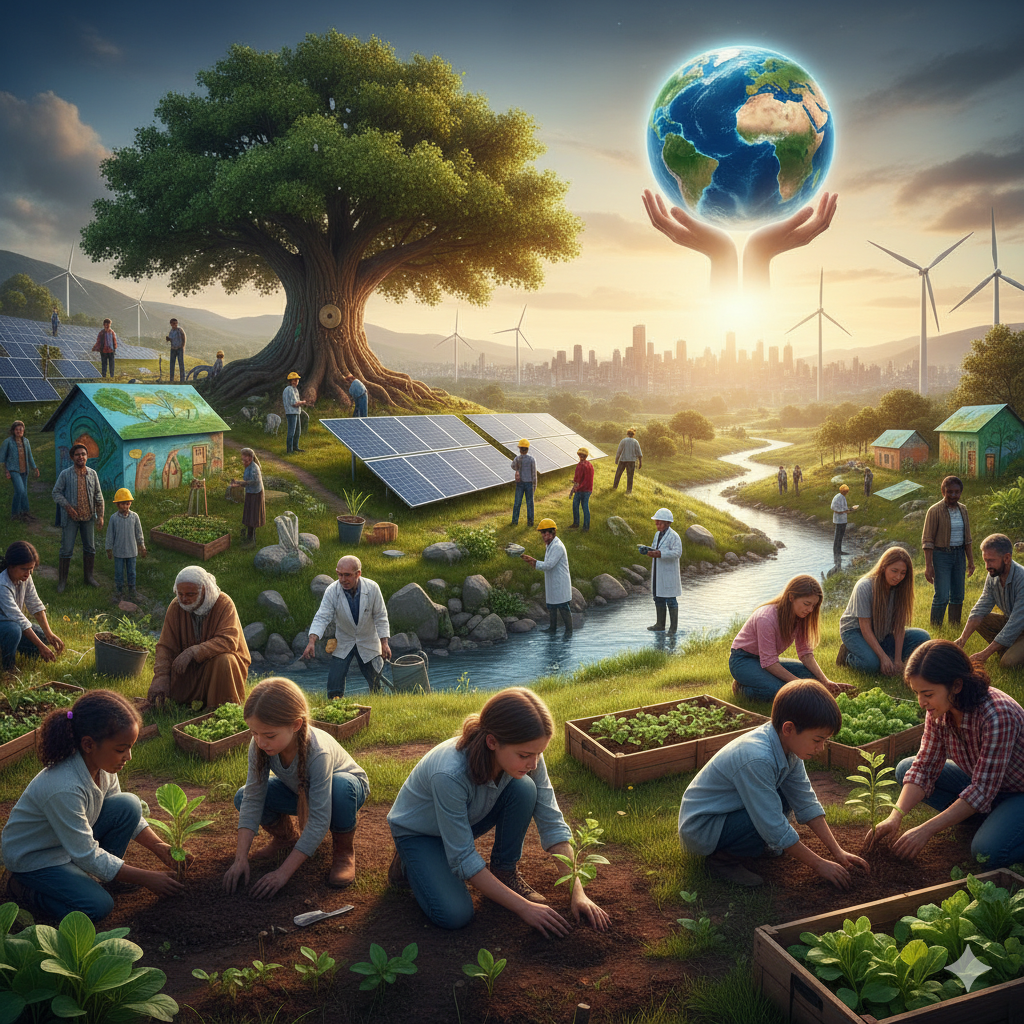
But despair is not the answer. The same hands that destroy can also rebuild. Communities across the world are planting forests, reclaiming polluted rivers, and demanding clean energy over fossil fuels. Every individual choice—from reducing waste to supporting sustainable practices—adds up to a collective force for change. Change begins with awareness, but it thrives on action.
And each of us holds a part of that change. Small actions may feel insignificant, but multiplied across millions of people, they reshape entire systems. Choosing public transport over private cars, refusing single-use plastics, supporting businesses that prioritize sustainability, or even planting a single tree—these decisions create ripples that grow into waves. Most importantly, raising awareness and holding leaders accountable ensures that environmental responsibility is not left to a handful of activists, but embraced by all. The Earth may be veiled in smoke today, but if we act with urgency, we can still clear the skies heal the wounds, and leave behind a living, thriving planet for generations to come. We are the authors of its next chapter. The question is no longer whether we can—it is whether we will.
“Every small choice is a seed for a healthier Earth—plant yours today.”
While the crisis may feel overwhelming, change begins with simple choices we all can make. Walk or cycle instead of driving, when possible, switch to reusable bottles and bags, eat more plant-based meals, reduce waste, and save energy at home by turning off unused appliances and sealing leaks. These may seem small, but multiplied across millions of people, they create powerful ripples of change. By choosing wisely in our daily lives, we not only lighten our footprint but also send a clear message—that a cleaner, healthier Earth is everyone’s responsibility.
Yet, we continue to turn a blind eye to the very real and visible effects unfolding before us. We forget that the only reason we exist—living, breathing, and thriving—is because of Mother Earth. Ignoring her cries of pain and warnings is, in truth, nothing less than destroying ourselves. No amount of wealth, power, or social status can restore what is lost once nature reaches its breaking point. It is high time we recognize that we are not separate from this planet; our very survival and livelihood are intertwined with hers. Protecting the Earth is not the responsibility of a few, nor a matter of choice—it is a shared duty, a collective responsibility that belongs to each and every one of us. The time for indifference has passed. The time to act is now. The sky clears; the Earth heals—one mindful choice at a time as every small choice is a seed for a healthier Earth—plant yours today.
Remember that Nature is powerful enough to heal without us, but we are too fragile to live without it. “The Earth will outlast us—but whether it nurtures us or rejects us depends on how we treat it today.”
 SoulMapStories.com
Leave a comment